Showing posts with label Profiles. Show all posts

Tuesday, January 7, 2014

Meet Val Anderson

By Emily Ostrowski

 One of the things we here at YWCA Clark County always love to do is acknowledge the incredible work and dedication of our employees and volunteers. Val Anderson is someone who is absolutely deserving of such acknowledgement. She has been with YWCA for 21 years and currently serves as the administrative specialist for our CASA Program. Val previously served as a clerk-stenographer, as well as an office manager for a federal government agency in downtown Portland. After the birth of her daughter, she took several years off work before deciding to look into getting a part-time job. She found an ad in the newspaper for an office assistant for the CASA Program and hasn’t looked back since.
From L to R: Heidi, Val, and Kathy
Val takes a great deal of pride in her work, and knows the importance of the CASA program. She understands that the work the staff and advocates of CASA do is unique and necessary to improve the lives of so many children in the community.

CASA Program Communication & Training Specialist Heidi Hiatt has worked with Val for several years, and can speak firsthand to her work ethic and passion. “Val is an amazing person. I had the pleasure of sharing an office with her for about a year. While “living together” I was able to witness directly how passionate she is about serving our program, the advocates, and the children and families we work with.”

 A large part of Val’s job is reading through countless abuse and neglect cases, a task which can be disheartening, but she makes sure to find ways to cope with the stress whether it be talking with a co-worker, taking a walk, or going across the street to Safeway for a maple bar! Val also has an excellent sense of humor. “Val and I are fairly close to the same age and we both find we have the same complaints about growing older; but we can laugh about it all so hard that we have tears running down our cheeks,” says co-worker Kathy Shirilla , “I love her sense of humor!”

 Beyond her sense of humor, Kathy also recognizes Val’s dedication to her work. “She always works hard and puts in all that extra effort needed to complete the job giving full attention to detail. She respects everyone and is always there to help.”

 Without a doubt, Val recognizes that the work done by CASA is a group effort, and has nothing but encouragement for any potential CASA volunteers, “You DO make a difference. You make it better, even when you think the “system” is slow or sometimes even broken. All you do adds up for the child.”

 However, CASA wouldn’t be the same today without the work of Val Anderson, says Hiatt, “She is really the backbone of our program, and I don’t think she realizes how valuable she is to the advocates and staff she works with.”

Wednesday, July 3, 2013

Volunteer Spotlight: Blayne Amson

“There’s a camaraderie among the staff who work here, but also within the SafeChoice Program – to advocate for me, to recognize the gift that I bring to the program and to acknowledge those unique understandings that I might bring.” These are just a few of the things that inspires him to stay, says Blayne Amson, whose been with YWCA for about a year – first as an intern and later as a volunteer. Also impactful has been his experiences as an advocate as well as the organization’s dedication to model their mission. In addition, Blayne is passionate about promoting inclusive and empowering behavior, especially as it relates to ablism. With 6 years of women’s studies and a selfless, compassionate personality, Blayne is a welcomed advocate in the SafeChoice Domestic Violence Program and within the organization as a whole.

While Blayne was an intern, he gained 6 college credits and the advocate training required to support those affected by domestic violence. Now, as a volunteer advocate, he finds the work more rewarding than he ever expected. “I came in here with a lot of fears about how I would be perceived by survivors who are predominantly women, and ironically I found it to be a lot more of asset that I’m a man, than a deficit,” said Blayne. Additionally, he had some fears about advocating for those affected by domestic violence, being that it’s such an intense stage of life the participants are experiencing. But, within the first few minutes of talking with those he advocates for, he’s found his fears quickly slip away and are replaced with hope and joy. It’s provided him the perspective to truly value the relationships he does have and the pride in knowing that he helps people out of abusive situations so that they can regain their passion for life.

Blayne’s not the only one who finds value in his dedication to the organization. Saron Nehf, who works with Blayne said, “He is one of the most amazing allies I have ever met. He is thoughtful, driven, educated, dedicated, compassionate and I cannot wait to see how he will rock the world we live in, in the near future. I feel blessed to have met him and strongly believe that what he brings to our work is revolutionary and priceless.”

Blayne’s contributions to the organization are vast. Beyond advocacy support, he provides strong personal testimony regarding ableism which has engaged the support of many staff members at YWCA clark county. Blayne recognized that at YWCA, he has an opportunity to educate staff about oppression as it relates to people with disabilities. As someone who spends much of his time in a wheelchair, Blayne understands first-hand what it’s like to be the target of ableism. The majority of staff at YWCA don’t have any obvious physical disabilities, so from a target/agent perspective, most staff would be considered the agent, or the person in power who is also the potential source of oppression. This dynamic naturally puts able-bodied staff in an opportune position. Just as males are in a primary position to speak out against sexism, the able-bodied are in a primary position to speak out against ableism. With such an empowering culture, YWCA Clark County is fertile soil for growing Blayne’s dreams of empowering disabled populations. He quickly discovered that compared to his experiences volunteering in numerous other agencies, he needed to do the least amount of work to enlighten people and to create change. “The path has already been blazed for me,” he said, noting YWCA’s powerful mission, wonderful staff and bold anti-discrimination statement.

YWCA Clark County’s mission to empower women, eliminate racism and promote peace, justice, freedom and dignity for all resonates strongly with Blayne. He wakes up at 7:30 in the morning and takes 2 busses to arrive at 9:00am, but he says it’s worth the effort to come in and see the mission statement on the wall and think to himself, “yeah, me too.” Blayne admits that his work here is sometimes challenging, stressful and even draining, but with staff support, he personally feels empowered in a very unique way. “I’m given a lot of freedom while also having the ability to ask for guidance, and not being left to my own devices.” In addition, he feels secure in knowing he can bring concerns forward to his supervisor without being devalued.

Speaking of his supervisor, Lee Watts has only good things to share about Blayne, “He’s so compassionate, kind and provides a strength-based approach with the people he meets with.  I have so much gratitude for his decision to share his advocacy skills with SafeChoice. I couldn’t express it any better than a survivor who left a comment for Blayne after seeing him recently, ‘Thank you for HOPE!’ Blayne has given her and many others who have come through our doors hope for a better future—leaving here feeling empowered to change their lives. He really is an amazing advocate.”

Monday, March 11, 2013

Meet Barbara Kuzmic

YWCA Clark County welcomes Barbara Kuzmic as the new Director of the Clark County CASA Program. Since early January 2013, when Barbara moved to the Pacific Northwest from the mountains of Colorado, YWCA Clark County has been fortunate to have her unique skills and experiences driving the CASA program.
Barbara Kuzmic

CASA (Court Appointed Special Advocates) is a nationally accredited advocacy program administered for Clark County by YWCA. CASA’s are specially trained volunteers who advocate for children that are involved in the court or foster care system. As a voice for the child, a CASA ensures that the child’s interests are represented.  Barbara says, “Our volunteers are extremely brave and have huge hearts, and I’m very impressed by that.”

Barbara advocates for women and children throughout her entire career. She earned a Bachelor of Science in Applied Behavioral Science at Bastyr University in Seattle, Washington, using her knowledge to empower women and enhance the lives of members of underserved communities ever since. After completing Masters coursework at the California Institute of Integral Studies, she worked as a private psychotherapist specializing in treating victims and perpetrators of criminal violence of physical and emotional abuse.

She also served as a private consultant for behavioral health companies, assisting them with recruiting, structuring and training. She honed her expertise with several organizations in different states, managing social programs, counseling and advocating for adults and juveniles with substance abuse problems, liaising between families, police and courts, and establishing organizational policies regarding drug testing. This work required sensitivity to the cultural norms of the communities she was working with, including American Indians and Native Hawaiians.

These experiences makes Barbara uniquely suited for directing the CASA program here in Clark County. Her work with perpetrators and victims, as well as her strong organizational background, allow her to bring a mixture of compassion and common sense to the position so that CASA can help as many children as possible. Her primary goal as CASA director is to ensure that all of the children in the CASA program are assigned an advocate. National standards dictate that there must be one paid staff member to every 30 CASA volunteers, so Barbara is in the process of obtaining funds in order to hire more staff to support more volunteers. This will ensure that all of the approximately 800 Clark County children who require advocacy receive it.

April is Child Abuse Awareness and Prevention Month nationwide, and it is an ideal time for communities to raise awareness of child abuse and prevention. Barbara encourages anyone in the community who would like to make a difference in the life of a child to visit YWCA Clark County, and sign up to volunteer. Contact Stephanie Barr, Director of Volunteer Development at 360 906 9112 or sbarr@ywcaclarkcounty.org to learn more about volunteering with CASA.

Friday, January 4, 2013

Val Joshua, Dedicated Leader

By Sharon Svec

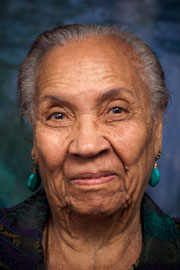
Val Joshua
Champion, hero, leader, dedicated, patient, inspiring, sweet, great; these words can only describe one person. Valree Jacqueline Joshua was a beacon of light for struggling souls and a model of social justice. As I connect with co-workers, family and friends of Val, I see one common theme: dedication. Val was dedicated to her family, her church, and to her community.

Val spent her youth in Gilmer, Texas and it was then that she first joined YWCA. She was 22 years old when she moved to Vancouver in 1942. She quickly became a part of the community through her church and participation in organizations such as YWCA Clark County, the Urban League or Portland and the NAACP. Through her involvement, Val extended her passion for human rights into the community. In the last 70 years of her life, she witnessed the growth of Vancouver in size and in social justice. Her efforts in the community lead to desegregation of housing, teaching, and places of worship in Clark County.

Val recognized discrimination beyond racism. Daughter, Jackie Webster thinks that may have been what prompted Val to start her work with women inmates at the jail. Most jail and prison systems in the United States are designed to address the needs of men, but by 1993 women accounted for 9.3% of the jail population nationwide.  In addition to the unique medical needs of women, the majority of women in jail are mothers. Because many facilities do not take females, many are displaced from their communities, making it even more difficult for children or family members to visit. Family ties could quickly unravel without means of communication.

Along with friends Helen Bussey and Margaret Crandall, Val started the WORTH Program in 1973 to bring equality and hope to women in Clark County jail.  Val’s dedication shined stronger than ever. “She truly believed in it and wanted to try and make a difference in the lives of these women,” said Jackie, who now serves as Custody Chief at the Clark County Jail. For nearly two decades, WORTH primarily supplied women with cards, envelopes, nail polish and undergarments. Val was responsible for the cards, envelopes and paper. She would bring them to the jail every Tuesday. Each woman could write two letters, and Val would take the letters back and mail them for the women. By empowering incarcerated women to write, Val opened communication lines and gave them a voice they had never known before.

Val’s dedication to eliminating racism and empowering women did not go unnoticed. She served two terms on the YWCA Clark County board of directors, was voted Board President in 1976 and is honored annually at our Community Celebration where the Val Joshua Racial Justice award is presented to an individual, business, or organization whose efforts support the mission of YWCA Clark County. The award was originally presented to Val in 1989 for her lifelong commitment to, and work for the elimination of racism. Val’s dedication to eliminating racism was exemplified in her community outreach to schools and community leaders.

In an interview for “The Center for Columbia River History’s Vancouver African American History Project,” Val shared an example of how she always “rolled up her sleeves” and went out to talk with anybody who expressed a need to learn more about racial equality:

“In the YWCA, the friend that was CEO at that time is still living, and she and I became very good friends. She started her life membership with the local chapter and anytime there was anything going on we could always gather people. One time we went down to a forest area somewhere down the Columbia River Gorge to a black girl who was teaching there. Her husband was a forester and they had three children and I can’t remember exactly what the issues were, but we went and they were having a board meeting that night and would not let us stay at the board meeting… Of course, they wanted their children to grow up in an integrated area, so she moved to Vancouver and she’s still teaching in Portland, but the husband and father lives back East. We’ve always taken an interest. Anybody that calls me and wants me to go with them to court, to a school, I will go if I’m not already doing something.”

It’s that commitment and dedication that made Val’s work in racism and at the Clark County jail so successful. YWCA Clark County will continue to honor Val annually with the Val Joshua Racial Justice Award. Beyond our humble efforts to memorialize Ms. Joshua, her legacy will surely thrive in Clark County where she reached out to so many community members personally, touched so many hearts and inspired so many with her good nature and strong values.

Tuesday, October 30, 2012

Intern Spotlight: Marty Josephson


By Sharon Svec

Marty Josephson is a student at Clark College and intern at YWCA Clark County. As part of her Administrative Assistant degree, Marty is required to take a minimum of 6 credits for BTEC 199-Cooperative Work Experience. The class description calls for, “supervised on-the-job work experience in an approved job in the local community with specific learning objectives and employer evaluation.” Marty found the perfect fit at YWCA Clark County.

Ultimately, she wants to work at an organization that aligns with her values and helps the community. When she saw the Y table at Saturday in the Park, she knew it was the place for her, “I’ve had some unfortunate situations throughout my life and have had nobody to count on. So when I saw some of the things the Y did, I thought it was important for me to be a part of that.” She’s currently in her 2nd quarter of interning as an administrative assistant and is hopeful to return for one more quarter of on-the-job work experience.

Marty, hard at work.
Since she began, Marty has had a range of experiences to learn from. She has worked with Accounting, SafeChoice, and the Department of Development and Communications doing tasks such as file management, formatting large documents, creating powerpoint presentations and implementing website revisions. Marty said she finds the experience gratifying, “When you go to a job or to school and you feel like you just don’t want to go in, then you know you shouldn’t be there. I never feel that way. I look forward to coming here.” Y staff feels just as thrilled about working with Marty. Grant writer, Megan Dixon stated, “After our first meeting, it was obvious that she has a true passion for helping others and giving back to our community. Her blend of cheerfulness and capability make her a joy to work with.”

YWCA Clark County is dedicated to making every experience empowering, not only for those they serve, but also for the staff, volunteers and interns who work so hard to keep the organization functioning at optimum capacity. “It’s really important to me that interns feel like they’re gaining something from the experience as well, which is why I encourage supervisors to help interns set professional development goals and provide consistent feedback on how they are progressing toward those goals,” said Stephanie Barr, Director of Volunteer Development who serves as an ambassador for interns and volunteers.

Whether you are or are not a student, if you’re interested in expanding your skill set and working in an empowering environment that serves the community, YWCA Clark County may be the place for you. Take it from Marty, who said, “I think YWCA has a very good understanding of internships, and helping people succeed in their life and on the job.”

To learn more about internships at YWCA Clark County visit our website, or contact Stephanie Barr at 360 906 9112 or sbarr@ywcaclarkcounty.org.

Tuesday, September 4, 2012

Raising the Barr in Berlin

We’re proud to announce our director of volunteer development, Stephanie Barr, was invited to speak in Berlin on her thesis paper which focused on solidarity within a diverse feminist movement.

Stephanie presented her paper called “What Unites Us? Effective strategies for Fostering Solidarity Within a Diverse Feminist Movement” this past July at an international conference titled Collectivity Beyond Identity. The three day conference was organized by and held at the Center for Transdisciplinary Gender Studies at Humboldt-University of Berlin. It hosted 38 speakers from the US and Europe including famous feminist theorists Linda Alcoff, Linda Zerilli, and Adriana Cavarero. The base question presented by the conference was, “How might we rethink the notion of community and how can we conceive of collectivity, when the seemingly crucial aspect of collectivization – identity – has become the object of critical study?”

To learn more about Stephanie’s experience at the conference, I asked her a few questions:

How did you become interested in feminist theory?

I took some feminist philosophy courses in college that really impacted the way I view feminism. I identify more as an activist than an academic, but I think theory is really important because it informs our strategies for achieving social change. As feminist theory has evolved it has helped us better understand the role identity plays within feminism, power dynamics between feminists, and how we can become a more effective, increasingly inclusive movement. So for me feminist theory provides a framework for thinking about how I want to engage in this work.

How did you feel when you were invited to speak?

I had to apply to present at the conference, so when I heard that my paper had been accepted I was shocked and thrilled and a little intimidated. But mostly I was excited that I would have the opportunity to share my research with new people, and have the opportunity to meet other people with similar passions and learn from them.

How was your experience in Berlin, the city?

Berlin is an amazing place with a rich and complicated history. The people of Berlin have been incredibly thoughtful about not erasing the past—even the dark moments of Nazi Germany—but also looking towards the future with eyes wide open. I biked along what remains of the Berlin wall, covered in political graffiti, then relaxed on a sandy beach along the riverbank, just on the other side of the wall. I never knew what to expect. It is a unique mix of past and present, urban but integrated with nature. It’s diverse and has a relatively young and creative population, so for me that environment was fun and invigorating.

How was your experience at the conference?

The conference was stimulating and challenging, and at times overwhelming. As I said, I consider myself more of an activist than an academic, and feminist theory encompasses so many different disciplines that there was a lot of new information for me to take in. But it was also really inspiring to hear other feminist theorists present research about their passions and their visions for the future of feminism. Ultimately the conference was focused on feminist collective identity, so everyone was genuinely interested in how we can motivate more people to feel like they belong to the feminist movement. That gave the conference a great energy, I think.

What was your favorite part of the conference?

I enjoyed sharing my research. The big fear in academia is that no one cares what you’re doing and no one will ever read your research once you finish. So just getting to engage with other people and hear their feedback was exciting. A woman who works in Sweden for the European Women’s Lobby asked to read my thesis, and that felt incredible.

I also really enjoyed a talk on Jewish queer poetry presented by a woman from Israel. It made me think about what creates a sense of belonging, and how powerful it can be to rediscover and celebrate your identity within a community that made you feel unseen in the past.

Will you be presenting your paper again in the future?

Not exactly that paper, but I’m investigating ways to present my research here at the Y. I’m so grateful to work somewhere that recognizes the connection between my research and the work that we do. It would also be great to continue using it to develop concrete strategies that organizations can put into practice. My ultimate goal is to be able to write a short paper on specific strategies non-profits could use to explore the issues of diversity and solidarity within their organizations. I think the research applies beyond feminist organizations because it’s really about doing coalition work and what that brings up for people.

Were there any speakers or topics there that you were particularly excited about?

It was a real honor to hear some of the keynote speakers present their work. One remark that has stayed with me was shared by Linda Zerilli. She said that feminism keeps trying to devise the perfect theory to address power imbalances, and no perfect theory exists. There are strategies for dealing with power dynamics in practice, but there is no single theory that will solve all of these problems. I really appreciated hearing that because I think striving for perfection is great, but expecting perfection can make us miss the huge strides we’re making and actually become an obstacle to moving forward.

What new or exciting concepts did you walk away with?

One of the other US presenters on my panel researched how multiracial Black youth form a collective identity with their peers in school. Her presentation expanded my understanding of some of the challenges people who identify as multiracial might experience, particularly during their teen years when so many are seeking understanding and acceptance. It was another reminder of how complex and personal identity is for each of us.

Would you do it again? 


I would, although most likely with new research. It was an incredible learning experience to meet feminists from so many different parts of the world and hear about the research they’re conducting. I definitely think the experience of sharing ideas with people who have similar passions is worthwhile.

What advice do you have for aspiring feminist theorists?

You may not know how you’re going to apply it once you graduate, but if you can find the funding and make the time, the degree is worthwhile and can lead you to new opportunities. Choose to research topics that have some practical application because that’s how you can really make an impact. And finally, even if you research the worst results of sexism, it helps to focus on solutions. One of my mentors once told me “you can’t work towards a better world if you don’t believe it’s possible.” Retaining that optimism is essential. It makes all the difference to nurture your hope and to remember that there is a whole movement of people committed to the same goals. That, above all, is what I get from participating in feminist communities of all kinds, and that’s why I wanted to study feminist solidarity. I hope that anyone committed to gender based justice can find a place to belong, because there is so much potential in our collective power. Like we say at the Y, strong alone, fearless together.


Volunteer Spotlight: Rick Sievers

After separating himself from volunteer and social service work for over a decade, Rick Sievers has found happiness volunteering with YWCA’s Sexual Assault Program.  Rick has been volunteering with YWCA for about a year and a half and said he finds the work healing. A survivor of childhood sexual abuse, Rick felt he wanted to help, just as he had been helped. He also recognized that men are usually the aggressors. As a volunteer, he wanted to find opportunities that were rewarding to him, yet sensitive to the needs of the survivors. Group facilitation was the answer.

Rick is currently co-facilitating two groups offered by the Sexual Assault Program: the journaling group and the men’s group. He’s always found journaling to be a great benefit to his own recovery and wants to share his “$5 therapist” with other survivors. “My journal is like a friend,” said Rick. “I can write whatever I want in it. I don’t have to have correct punctuation. I don’t have to be politically correct. I don’t have to be kind or nice… but I still am,” he added with a smile. The journaling group is for women 21 and older who have been affected by sexual assault. Attendees do not have to say they’ve been assaulted, or that they’ve been a survivor.  During the group sessions, Rick wants to help people find safety within themselves and beyond; “Can we access that safe place within ourselves through journaling, and can we find someone who can support us in our lives?”
Laurie Schacht, SAP Director sits with Rick Sievers.

The men’s group is available to males 18 and older who have been affected in any way by sexual assault. It’s a 5 week forum for men to make connections with each other and to discuss what it’s like to be a male in our society. In Rick’s experience, the expectation was that, “You’re not allowed to have feelings. You gotta be tough.” Societal expectations like these can be compounded for those affected by sexual assault. Rick sees this opportunity as a time to address the impact of those expectations and to provide a space when men can connect, during a time when men may feel isolated from each other.

Rick says he will always be in the process of healing. He recalls more than 15 years ago when he was a social worker, “I would come home anxious and depressed. I would just lie on the floor and stare at the ceiling for hours. It felt like I put the cart in front of the horse, in some way.” He quit social work in ’96 and went to massage school, finding it to be a great way to start re-inhabiting his body. It helped him to be comfortable with safe touch, and to be comfortable as a male. After his partner died in 2005, Rick’s memories flooded back into his life. He sought therapy and joined a group. He found employment as a butler, which allowed him to really focus on healing. After 12 years of working as a butler, he retired, bought a farm, and turned on his radio. “I heard something about the sex scandal in the church, and I thought, ‘this isn’t about sex, this is about rape.’ I wanted to do something about it. I thought ‘maybe I could participate and help some way.’” And so, the volunteering began.

Rick knew when he met Laurie and the other staff at the Sexual Assault Program that he made the right choice. While going through training, he started to see a whole other dynamic at YWCA that he would be navigating: being a male in an agency whose mission is to empower women and eliminate racism. “As a male, consider why you want to volunteer here: Is to be a human being, to explore your own life, to really be of service, or is it to protect women and children?” said Rick. For him, it’s about focusing on human kindness, “Men often see themselves in a protector role, but what are you saying about women by saying you want to protect them?” As a male, he thinks it’s most important to be yourself, but to also be very open to new ideas. He said the training and workshops opportunities offered at YWCA have really helped him to explore himself and continue his journey of healing. Rick said, quite eloquently, “If you’re gunna volunteer, this is the place to do it, but don’t do it for somebody else, do it with somebody else.”

If you’re interested in volunteering, contact Stephanie Barr, Director of Volunteer Development at 360 906 9112 or sbarr@ywcaclarkcounty.org. To learn more about the two groups Rick will start co-facilitating this month, contact us at 360 696 0167, or view the flyers online: Journaling Group, Men’s Group.

Be the Change with Naomi Tutu

Be The Change, Every Day

Every day activism is a movement that is gathering momentum around the world. To be an every day activist means that you belong to a community of people who are dedicated to taking individual every day actions to help change the world for the better.  We are that community.

Act today by registering to attend the 18th annual YWCA benefit luncheon where Naomi Tutu will speak to the understanding how our actions – or inactions – affect all with whom we come in contact and ourselves.  Tutu encourages us to focus on our shared humanity in order to build a just world.

The challenges of growing up black and female in apartheid South Africa is the foundation of Tutu’s life as an activist for human rights.  Those experiences taught her that our whole human family loses when we accept situations of oppression, and how the teaching and preaching of hate and division injure us all.

A Leader Social Change

YWCA’s Social Change Program is dedicated to preventing racism and other forms of oppression in our community through education and support. Presentations at area schools  increases youth civic engagement to eliminate racism and oppression, creates respectful school environments and builds inclusive communities. Workshop leaders assert that when we engage in the most challenging conversations we create amazing opportunities for growth and change together.

YWCA also works to eliminate racism and other forms of oppression through the education and advocacy provided in our seven programs and volunteer training. Resources for eliminating racism and oppression are available by contacting YWCA Clark County.  We encourage all to take action as an ally against oppression on an individual, community, organizational and institutional level.

Naomi Tutu, Advocate for Change

Naomi Tutu is a lifetime advocate of human rights. Daughter of Bishop Desmond Tutu, she was born in apartheid South Africa, but later lived in Lesotho, the United Kingdom, and the United States. Tutu served as a development consultant in West Africa and coordinated programs for race and gender awareness at the African Gender Institute at the University of Cape Town. She is a consultant to two human rights organizations, the Spiritual Alliance to Stop Intimate Violence (SASIV) and the Foundation for Hospices in Sub-Saharan Africa (PHSSA). Tutu has led workshops for conflict resolution and issues of race and racism, as well as women’s retreats through her organization, Sister Sojourner.

Her professional experience ranges from being a development consultant in West Africa to being program coordinator for programs on race & gender and gender-based violence in education at the African Gender Institute at the University of Cape Town. In addition Tutu has taught at the University of Hartford, University of Connecticut, and Brevard College in North Carolina. She served as program coordinator for the historic Race Relations Institute at Fisk University, and was a part of the Institute’s delegation to the World Conference Against Racism in Durban.

Accepting the Challenge

Naomi has been challenged to follow her own path in building a better world. She has taken up the challenge and channeled the opportunities she has been given to raise her voice as a champion for the dignity of all.

Will you accept the challenge?


Monday, May 7, 2012

Volunteers Phyllis and Bob Burger

Maintaining a shelter is not an easy job. It takes a team of dedicated individuals. YWCA’s SafeChoice Domestic Violence Shelter has 10 rooms, private and shared bathrooms, a shared kitchen, pantry, donation closet, laundry facilities and shared spaces for children, youth and adults. With an average of 25 residents living in the shelter daily, you can only imagine the degree of regular service and maintenance that’s needed to sustain a well-functioning operation.

Debbi Cawthon, Director of Shelter Services leads the charge with the staff support of Beth Landry, Shelter Facilities Specialist and Melissa Heiskari, Facilities Coordinator. Because the responsibilities these individuals have reach far beyond building and inventory maintenance, they rely on the dedicated service of volunteers to help fill the gap.
Phyllis Burger

Phyllis and Bob Burger have been filling that gap since 2007. In the last 5 years, Phyllis has found a perfect fit at the shelter. “I don’t mind doing odd jobs that no one else wants to do,” Phyllis said. She spends 10-20 hours a week there, where most of her work is focused on organizing the constant stream of donations received. Yet, her commitment doesn’t stop there. When Phyllis isn’t sorting diapers and blankets, she’s painting, doing laundry, or organizing the pantry. Occasionally she’ll discover a broken chair, ruffled blinds or a faulty door knob. Most businesses would trash the item and buy a new one, but for the shelter this is not always the best option. That’s when Phyllis calls on Bob. As Bob sees it, “She’s always finding volunteer types of jobs to do, and I’m the tag-a-long.”

Bob enjoys fixing things and joins Phyllis from time to time for small projects. Most recently, the couple worked together on some projects in the building. Now, they’re looking forward to working together on painting the door frames, the elevator and maybe even some of the rooms. The work of these two is especially meaningful to shelter staff. “Phyllis and Bob seem to complement each other, and they’re part of the shelter family. Like many non-profits, we’ve had some struggles, and these two consistently step up and support the program,” said Landry.

Besides the work they do at the shelter, Phyllis and Bob are known throughout the community as committed volunteers. They’re both involved in FISH of Vancouver and their local church. Phyllis also volunteers for RSVP, SHIBA, Volunteer Connections and the Vancouver Food Bank. With so much experience volunteering, YWCA Clark County has utilized Phyllis’ expertise far beyond her shelter work. Stephanie Barr, Director of Volunteer Development has recently worked with her on recruitment and training efforts, “She’s willing to help in any way she can and always has a great attitude. She sees a need and offers to help. It’s wonderful!”

It seems the feeling is mutual. Phyllis says the work YWCA does is amazing and she’s especially fond of the free training sessions that YWCA offers to staff and volunteers. “I learn so much. It’s like taking a college course, and I recommend them to anyone and everyone,” said Phyllis. She especially enjoys learning about equality efforts and gaining insight on domestic violence and sex trafficking issues. “I think it’s one of the strengths of the Y that they do have good training sessions, and they do have a lot of outside people come in to lead the training.”

YWCA Clark County is grateful for the time and talents of this thoughtful and committed couple.  Their service goes above and beyond all expectations and this dedication is recognized by so many in our community. In March of this year, Phyllis received a letter of recognition on behalf of Governor Christine Gregoire and the Washington Commission for National and Community Service, congratulating her on her outstanding volunteer efforts in the community. She was invited to receive an award at the Executive Mansion in Olympia and to attend a public recognition Salute to Volunteers at a Mariners pre-game event. We congratulate Phyllis for her well-deserved award and also extend congratulations to her husband Bob, who has also done so much to support this organization, and our community.

Sunday, January 8, 2012

volunteer spotlight: donna weinman

“I’m your advocate. Do you know what that means? I’m here to support you. I don’t need to know what happened. I don’t need to ask you questions. All I do is be there if you want me to be there and tell you what’s going to happen if you want to know. And go through the entire process with you for as long as you want me there. Everything you choose to share with me is confidential.” With these words, Donna Weinman opens doors and changes lives.

Donna advocates for individuals who have been sexually assaulted. She supports them as they move through what can be a very confusing and difficult experience. Currently, she has about 5 or 6 individuals that she’s supporting, all at various stages of healing and prosecution. Sometimes she meets the individual at the hospital soon after they’ve been assaulted. Other times, she’s involved later in the process.

Donna stays with the assaulted individual until the case is resolved, providing resources, tools, and most importantly a presence. If charges are brought and it goes to trial she stays with them until the very end. Beyond that, she offers them the opportunity to continue talking with her if they so desire.

The work is “richly rewarding and deeply painful at the same time,” says Donna.

Painful, because it’s upsetting to know that there are others out there who are facing this alone, without any idea of what to do, or what will happen next. The reward, she said comes when you see the change you’ve made in a person’s life, “One of my clients said something to me that really says it all, ‘No one has ever stood up for me. You stood up for me.’”

Donna Wienman has always enjoyed volunteering. Before joining ywca’s team, she volunteered for 12 years on a suicide crisis line. During this time she recognized that a number of callers experienced sexual assault or violence in their lives. While her work at ywca is different, this experience, combined with ywca’s thorough training made it easy for her to transition into volunteering for the Sexual Assault Program.

Donna recognizes that there is a huge need for her services, and aside from helping people, she sees volunteering as an excellent opportunity to help herself grow as an individual and community member. In her own words, “Part of it is the camaraderie and the purpose that make it very special.” For those considering volunteering, Donna says not to be intimidated by the details, “just show up, and you’ll love it.”

Her service and commitment don’t go unnoticed. “Donna is committed to victims and their rights. She believes this work is important and really likes making a difference in her community,” said Joan Renner, Director of the Sexual Assault Program.

ywca clark county appreciates all of the wonderful volunteers who commit nearly 40,000 hours a year to supporting our programs and services, and welcomes those interested in volunteering to attend the Intro to Volunteering free class at our Community Building on Tuesday, January 10th at 6pm.

joan renner: local hero

Congratulations to Joan Renner, who was recognized as a Local Hero during the November 29th Bank of America Neighborhood Excellence Initiative Awards. Bank of America introduced the Awards in 2004 to strengthen and support communities by recognizing and rewarding community-based organizations, local heroes and student leaders working to improve their communities. Joan, Director of the Sexual Assault Program at ywca clark county was one of five individuals receiving the Local Heroes Award. She was recognized for her dedication to eliminating sexual violence in Clark County, and for impacting the community profoundly by inspiring the individuals, families and community she serves.

Joan became involved in anti-sexual violence activities in 1979 while working at the Women’s Resource Center and the ywca Domestic Violence Shelter. At that time there were no resources for victims of sexual assault, yet the need for free, comprehensive advocacy was great. Knowing this, Ms. Renner helped found the Sexual Assault Program at ywca clark county in 1980, where she created the framework for victim services and collaborated with local partners to help eliminate the stigma of sexual assault, extend services to marginalized communities, and develop prevention education opportunities. Currently, the program is the only provider of free, 24-hour crisis intervention and advocacy for sexual assault victims in Clark County. Joan also created a training program to prepare community members, law enforcement and social service employees with the tools needed to provide advocacy and crisis intervention. In addition to her career, Ms. Renner dedicates her time to social change activities including serving six terms as a board member for the Washington Coalition for Sexual Assault Programs, leading the Domestic Violence and Sexual Assault Taskforce, and helping to create the Children’s Justice Center.

Besides fame and glory, Bank of America awarded a $5000 grant to a non-profit of Joan’s choice. ywca clark county was the proud recipient and will apply the funds directly to the Sexual Assault Program. With businesses like Bank of America and heroes like Joan Renner we can achieve peace, justice, freedom and dignity for all.

Wednesday, March 16, 2011

ywca clark county program director invited to speak in Belarus

Vancouver, Wash. — ywca clark county is proud to announce that SafeChoice Domestic Violence Program Director, Debra Adams has been invited to speak on the topic of domestic violence in Minsk, Belarus from March 22nd through March 27th.

Starting out as a volunteer in 1994, Debra became Director of the SafeChoice Program in 2005. With a focus on Gender, Culture and History, Debra received her BA in 2003 and her MA in 2006. Currently, she is pursuing a PhD in Leadership and Organizational Change, as well as certificates in various domestic violence studies.

Debra’s long term goal is to do work on a National and International level, so when she received notice of the opportunity in Belarus, she immediately responded with a letter, resume and an article she’d written that chronicled her journey working at the ywca. Three days later, she received an email from the YWCA of Belarus inviting her to speak at the March 25th conference, “Combating Domestic Violence in Belarus: International and Local Experience.” Also while in Belarus, Debra will speak to college students and their social service provider about her experiences, and will attend a YWCA general assembly.

“I was really thrilled to hear the US Embassy would pay for my expenses: airfare, hotel, and interpreter. When they said that, I knew the y would support me. My whole 16 year career with the ywca has shown me that if they can support me, they will.” said Debra, when reflecting on the opportunity.

Debra continues to fulfill her career and personal goals. Because of her actions and interests, communities surrounding ywca clark county and YWCA of Belarus will gain valuable information and resources. Debra hopes to provide Belarus with experiences that could help them develop their responses. “If the people of Belarus can learn from our mistakes, maybe it will speed up their evolution of having good responses and intervention more quickly.” YWCA of Belarus has a lot of experience with human trafficking. Debra hopes to bring back information on that topic as well as cultural insights to help ywca clark county reach out and appeal to the local Eastern European and Russian communities.

Debra will journal her experiences at http://www.travelpod.com/travel-blog-entries/adamsdebra/1/1299535605/tpod.html. Community members are encouraged to visit her blog and share this once in a lifetime opportunity.

About the SafeChoice Program

The SafeChoice Program of ywca clark county commit to advocate for, educate, and support those affected by domestic violence. They strive to collaborate with our community partners to present the most helpful resources, information, and education about domestic violence.

About ywca clark county
ywca clark county serves more than 11,000 people each year who are victims of domestic violence, homelessness, sexual assault, child abuse and neglect, and oppression, as well as youth in foster care and incarcerated women.